

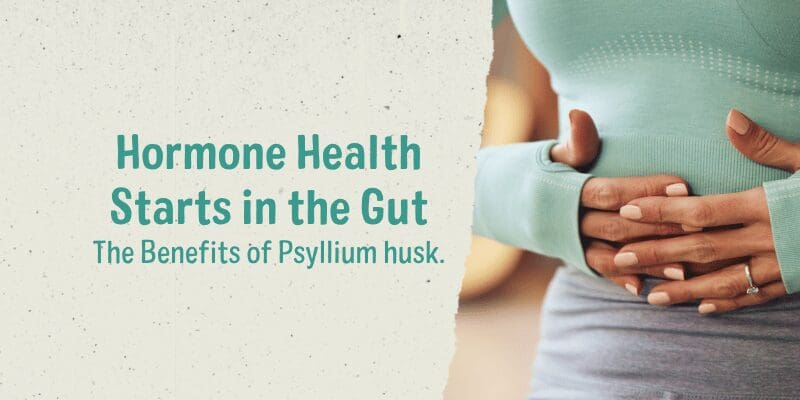
Hormone Health Starts in the Gut – The Benefits of Psyllium husk.
Oestrogen balance isn’t just regulated by the body’s ability to produce hormones such as oestrogen, but also our ability to break down hormones in the liver and excrete them efficiently from the body. This works best with a well-functioning gut and a healthy microbiome. Correct breakdown and excretion of hormones is important at all stage of life, but especially around our period and during perimenopause. Here, we cover the ins and outs of psyllium husk for hormone health.
When oestrogen has completed its work in the body, the liver packages it up and sends it to the gut for excretion as part of our natural detoxification system. These deactivated oestrogen parcels leave the body in our stool and urine. In a healthy gut, this process can be efficient, however if we suffer with constipation, lack sufficient fibre in the diet, or have imbalances in our microbiome, this process can get disrupted. This means that our gut can play a role in how much oestrogen is recirculated and how much is excreted.

The Importance Of Fibre
Fibre is currently a hot topic and with good reason. There are so many reasons why eating more fibre is good for our health, but research suggests that eating more fibre may also have a positive effect on circulating oestrogen levels. Fibre is thought to act directly on our digestive health and indirectly via its interaction with our gut microbiome. The mechanism of fibre supporting oestrogen excretion is well established; however there are only limited clinical trials
Both insoluble and soluble fibre absorb water which adds bulk and volume to our stools which in turn helps food pass through the gut more easily, preventing constipation and allowing for better excretion of waste products, including oestrogen. With over 90% of the UK population still not consuming the recommended 30g fibre a day, incorporating more fibre rich plants into the diet, such as healthy wholegrains, beans, lentils, vegetables, fruits, nuts and seeds can significantly help to boost fibre in the diet.
Soluble fibre feeds the trillions of bacteria that call our gut their ‘home’ which results in a healthier and more diverse microbiome. In fact, the gut has its own ‘estrobolome’, which is a group of bacteria in the gut capable of metabolising and modulating levels of circulating oestrogen. Eating sufficient fibre can help to keep this part of our microbiome balanced, more specifically by helping to rebalance certain types of beta-glucuronidase producing bacteria, such as E. coli, that have the ability to unpack the inactive oestrogen parcels sent by the liver and labelled for excretion. Instead of being excreted, these unpacked hormones could otherwise be sent back into circulation.
Both soluble and insoluble fibre are thought to help remove old oestrogen packages by binding to these packages, reducing the likelihood of them being reabsorbed back into the body, rather than excreted.
For a broader look at the benefits of fibre, including the difference between soluble and insoluble fibre, how much fibre you need each day and the best high-fibre foods to include in your diet, explore our complete guide to fibre
Psyllium Husk For Hormone Health
Psyllium Husk in the fibrous outer seed coating from the Plantago Ovato shrub. It is uniquely rich in fibre, containing around 90g fibre per 100g. Of this around 30% is made up of insoluble fibre and around 70% soluble.

A Nutritionists Guide
As a nutritionist, it is always best to eat a wide variety of fibre rich foods and not rely on fibre supplements. This is because foods that contain fibre are rich in vitamins, minerals and beneficial plant compounds which are good for our health. Some of these plant compounds have anti-inflammatory and antioxidant properties in the body.
Psyllium husk can be a helpful top up for some people. It is well tolerated by most people and has been shown in research to improve the consistency of stools, making them easier to pass and reducing the risk of constipation. Psyllium husk powder gives you the same fibre benefits as whole husk, without the grainy texture.
Psyllium husk has gained popularity as it form a thick gel when mixed with water. This means it has revolutionised gluten-free seed bread recipes as it binds the dough together in a similar way to gluten, but it can also be used to make jams and jellies or used as a food supplement.
These gel-like properties have other hidden benefits. By making the gut contents more viscous we can actively slow down the rate at which glucose is absorbed into the bloodstream which can result in more stable blood glucose. When our blood glucose is kept within tighter parameters, this can have a beneficial effect on our energy levels as well as having a steading effect on our energy and mood.
By increasing the volume in our gut, soluble fibre, including psyllium husk may also help to keep us fuller for longer, blunting cravings and reducing hunger. This can help to support our natural appetite cues when introduced as part of a healthy diet.
The important thing to remember when adding in fibre is start low and slow. Start with 5g to see how your gut reacts as increasing fibre too fast can result in bloating or discomfort. Fibre only supports our motility when it is hydrated and since soluble fibre can absorb multiple times its weight in water, it is important to add in and extra glass of water every time we consume psyllium husk so that it can absorb sufficient. In clinical trials the amount of psyllium husk used to ease constipation is around 10g per day, usually split into 2 doses. Each 5g teaspoon should be mixed with around 300ml water.
While fibre is incredibly beneficial to our health, we cannot replace fibre in natural whole foods with fibre supplements alone. They are be used as part of a healthy diet but should not be used in place of healthy whole foods.
For more information on the benefits of psyllium husk, how to use it safely, how much to take and why drinking enough water is important, explore our complete guide to psyllium husk.
Who is Dominique Ludwig?

Dominique Ludwig is one of the UK’s leading nutritionists, with over 20 years of clinical experience. She is a King’s College London–qualified nutritionist, Registered Nutritional Therapy Practitioner (CNHC), and a Fellow of the British Association for Nutrition and Lifestyle Medicine (BANT).
Dominique’s no-nonsense, science-backed approach, combined with her calm authority and delicious recipes, has built a fast-growing online community of over 700,000 followers, alongside thousands of participants in her online health and nutrition programmes.
She is a trusted voice in the media, contributing to publications such as The Sunday Times, Times2, The Telegraph and SheerLuxe. She has also featured on BBC Radio and numerous podcasts. Alongside her media work, she runs a thriving clinical nutrition practice in the South Downs, where her private clients include award-winning actors and global business leaders.
Over the course of three decades, Dominique has worked with more than 4,500 people. She specialises in her signature group programmes, Renew Reset Recharge® and the Triple 30 Nutrition Plan, which have helped thgitsousands achieve sustainable results and build long-term healthy habits. She is currently writing her first book.
She was recently awarded a Fellowship with BANT, recognising her outstanding expertise, leadership, and dedication to advancing the field of nutritional therapy.
Associations:
- FBANT – Fellow of the British Association for Nutrition and Lifestyle Medicine
- CNHC – Complementary and Natural Healthcare Council
Qualifications:
- MSc Nutrition, King’s College London, with Distinction
- Dip. Nutritional Therapy, with Distinction
References for Benefits Of Psyllium Husk For Hormone Health
Hu, S., Ding, Q., Zhang, W., Zhao, L. et al., 2023. Gut microbial β-glucuronidase: a vital regulator in female estrogen metabolism. Gut Microbes, [online]. Available at: PubMed. en.wikipedia.org+12pubmed.ncbi.nlm.nih.gov+12sciencedirect.com+12
Xu, L., Zhang, X., Zhang, Y. & Wang, Y., 2023. Gut microbial β-glucuronidase: A key modulator in the interaction between gut microbiota and host estrogen metabolism. Frontiers in Microbiology, 14, p.1106569. pubmed.ncbi.nlm.nih.govfrontiersin.org
van der Schoot, A., Drysdale, C., Whelan, K. and Dimidi, E. (2022) ‘The effect of fiber supplementation on chronic constipation in adults: an updated systematic review and meta-analysis of randomized controlled trials’, American Journal of Clinical Nutrition, 116(4), pp. 953–969. https://doi.org/10.1093/ajcn/nqac169
Kumar, A., Patel, R., Yadav, S. et al. Psyllium Husk: A Comprehensive Review of its Functional Properties, Health Benefits, Mechanisms of Action, and Potential Adverse Effects. Curr Nutr Rep 15, 13 (2026). https://doi.org/10.1007/s13668-025-00727-z



 No products in the cart.