What Are the Benefits of Psyllium Husk for Heart Health?
When we talk about heart health, your cholesterol level matters. In particular, LDL cholesterol is one of the key drivers of atherosclerosis, the gradual build-up of fatty deposits in the arteries that can increase the risk of heart attack and stroke.
For many people, improving cholesterol means looking at the whole picture: diet, physical activity, blood pressure, body weight, smoking, alcohol intake, family history and, where appropriate, prescribed medication. But there is one dietary factor that deserves far more attention than it usually receives: soluble fibre.

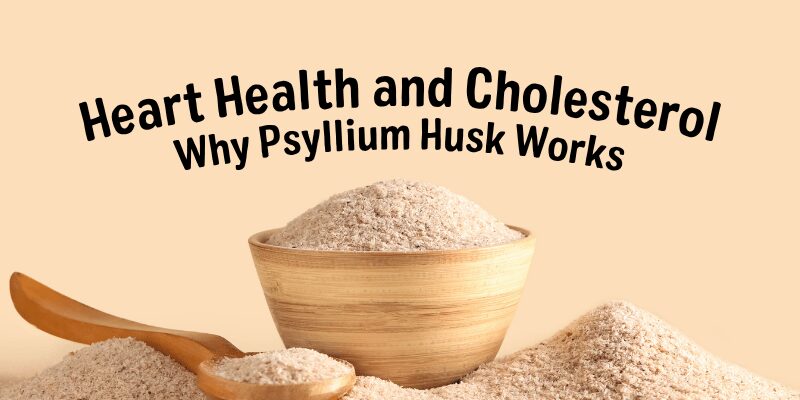
Psyllium husk is one of the best-studied sources of soluble fibre. It comes from the husks of the seeds of the Plantago ovata plant and has a distinctive gel-forming quality when mixed with water. That thickening effect is not just useful in the kitchen. It also helps explain why psyllium has been studied for its effects on cholesterol.
Here’s how it works. Your liver uses cholesterol to make bile acids, which are released into the gut to help digest fats. Normally, much of this bile is reabsorbed and recycled. Gel-forming fibres such as psyllium can interfere with that recycling process by trapping some bile acids in the gut. As more bile acids are lost from the body, the liver needs to use more cholesterol to make new ones. Over time, this can help lower the amount of LDL cholesterol circulating in the blood.
A systematic review and meta-analysis of randomised controlled trials found that psyllium supplementation significantly reduced LDL cholesterol, non-HDL cholesterol and apolipoprotein B. These are all important markers linked to cardiovascular risk. The effect is modest, but meaningful, especially when psyllium is used consistently as part of a wider cholesterol-lowering dietary pattern.
‘A reliable add on’ Using Psyllium Husk for Heart Health
Another meta-analysis, looking at psyllium added to a cholesterol-lowering diet in people with mild to moderate hypercholesterolaemia, found additional reductions in total and LDL cholesterol compared with diet alone. In other words, psyllium is a reliable add-on to an already heart-healthy way of eating, not a replacement for it.
That distinction is important. No single ingredient can undo an otherwise unhealthy diet. For heart health, the foundations still matter most: eating more beans, lentils, wholegrains, vegetables, fruits, nuts and seeds; replacing saturated fats with unsaturated fats; and following medical advice if cholesterol-lowering medication has been recommended.
Psyllium can sit neatly within that approach because it helps increase soluble fibre intake in a simple, measured way. One 5g serving of Linwoods Psyllium Husk Powder provides 4.5g of fibre. It can be mixed into a large glass of water, stirred into porridge, blended into a smoothie or added to recipes.

As with any fibre supplement, it is sensible to build up gradually. Psyllium absorbs water and thickens, so it should always be taken with plenty of fluid and never swallowed dry. If you have swallowing difficulties, a narrowing of the gut, or take regular medications, speak with a healthcare professional before adding it into your heart healthy plan.
In conclusion: Psyllium Husk for Heart Health as Part of a Balanced Diet
The take-home message is simple: heart health is built through daily habits. Moving regularly, not smoking, keeping blood pressure under control, eating a plant-rich diet and getting enough fibre all contribute. Psyllium husk for heart health is not a magic fix, but it is a well-studied, plant-based source of soluble fibre that can play a useful role in a cholesterol-conscious diet.
Enjoyed ‘Psyllium Husk for Heart Health’, learn more about Psyllium in our Complete Guide to Psyllium Husk.
About the Author

References:
- Gholami Z, Paknahad Z. Psyllium supplementation and lipid profiles: systematic review and dose-response meta-analysis of randomized controlled trials. Genes Nutr. 2025;20(1):27. doi:10.1186/s12263-025-00786-5.
- Jovanovski E, Yashpal S, Komishon A, Zurbau A, Blanco Mejia S, Ho HVT, et al. Effect of psyllium (Plantago ovata) fiber on LDL cholesterol and alternative lipid targets, non-HDL cholesterol and apolipoprotein B: a systematic review and meta-analysis of randomized controlled trials. Am J Clin Nutr. 2018;108(5):922-932. doi:10.1093/ajcn/nqy115.
- Anderson JW, Davidson MH, Blonde L, Brown WV, Howard WJ, Ginsberg H, et al. Long-term cholesterol-lowering effects of psyllium as an adjunct to diet therapy in the treatment of hypercholesterolemia. Am J Clin Nutr. 2000;71(6):1433-1438. doi:10.1093/ajcn/71.6.1433.
- Lichtenstein AH, Appel LJ, Vadiveloo M, Hu FB, Kris-Etherton PM, Rebholz CM, et al. 2021 Dietary Guidance to Improve Cardiovascular Health: A Scientific Statement From the American Heart Association. Circulation. 2021;144(23). doi:10.1161/CIR.0000000000001031.

 No products in the cart.