

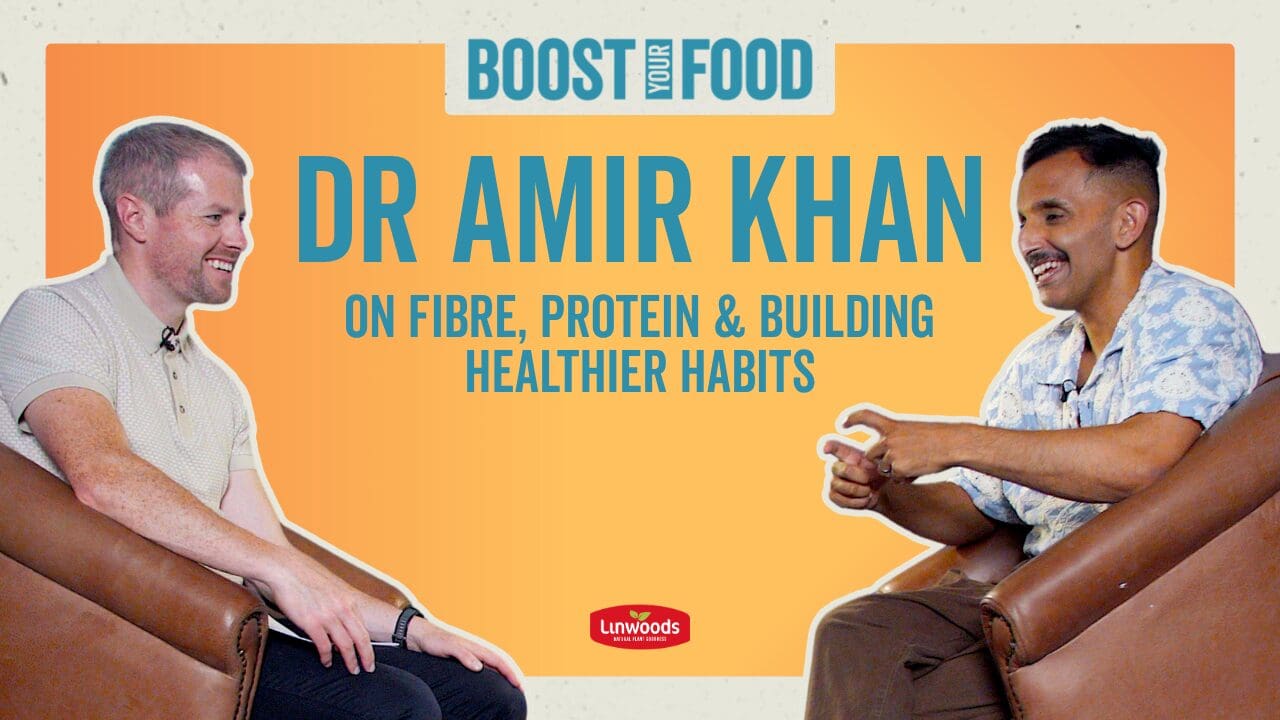
Getting More Fibre and Protein: Practical Guide from Recent Interview with Dr. Amir
Getting more fibre and protein doesn’t have to be difficult. Most of us know that fibre and protein are important, but understanding why they matter and how to get more into our diets can feel confusing. In this conversation, Linwoods Managing Director Patrick Woods sits down with NHS GP, author and broadcaster Dr Amir Khan to explore the growing interest in fibre and protein, the role they play in supporting everyday wellbeing, and why small, sustainable changes can make a meaningful difference over time.
Interview with Dr. Amir Khan
From gut health and healthy ageing to practical meal ideas and simple habit-building tips, this interview is a practical guide to getting more fibre and protein into your daily routine.
In This Interview
- Why fibre is having a moment
- Why most people still don’t get enough fibre
- The difference between soluble and insoluble fibre
- The connection between fibre, gut health and cholesterol
- Why protein matters as we age
- Easy ways to build sustainable habits
- How consistency beats intensity when it comes to nutrition
Fibre and Protein Interview
Patrick Woods in conversation with Dr Amir Khan
Patrick Woods💬: I’m Patrick Woods, managing director of Linwoods Health Foods, and today I’m delighted to be joined by Dr Amir Khan, NHS GP, TV presenter, author and podcast host. Amir, it’s brilliant to have you with us today.
Dr Amir Khan💬: Thank you for having me.
Patrick Woods💬: So Dr Amir, we hear a lot about fibre and protein at the moment in the news, in the media. Why are these nutrients getting so much attention?
Why Are Fibre and Protein Getting So Much Attention?
Dr Amir Khan 💬: I think what’s happening now is that we’re recognising the importance of both fibre and protein, particularly as we get older. Fibre, in particular, is having a moment, mainly because not enough people are getting enough fibre in their diet.
In fact, the vast majority of people in the UK are not getting enough fibre, and that now has been linked to so many health issues. Certainly, as a GP, I look after a lot of people with diabetes and cardiovascular disease, and we know that people who don’t get enough fibre in their diet are at increased risk of those two things, as well as other metabolic conditions. And social media has played a part as well.
“The vast majority of people in the UK are not getting enough fibre.”
We’ve got lots of health experts on social media who are talking about the importance of fibre and getting it through the day in every meal. When it comes to protein, it is probably less of a problem in terms of people getting enough protein in their diet. I don’t think many people are protein deficient in the UK in the true sense of the word.
However, what we do know about protein and collagen and all of these things that protein makes up is that we can a lose a lot of our muscle mass and collagen as we get older, particularly for women after the menopause. But even as men, you know, there’s a steep decline in protein and collagen production. We lose a certain percentage each year. So getting it through the diet, both for fibre and protein is so important for our health as we age.
What Can People Do to Increase Their Fibre Intake?
Patrick Woods💬: You touched there in terms of people not getting enough fibre in their diets. What can people do to change that?
Dr Dr Amir Khan 💬: So the key thing about fibre, even though it’s an essential nutrient for all of us, is that, if you don’t feel like you’re getting enough, don’t dive headfirst into this kind of fibre-maxxing trend, which I love. We should all aim to increase our fibre, but we have to build up to it. Our bodies have to get used to being able to move fibre through the body, because we can’t digest fibre that easily. You know, there’s different types of fibre. Different types work their way through the body in different ways. And it takes time. Like any good thing, it takes time for us to get used to it.
“We should all aim to increase our fibre, but we have to build up to it.”
So if you are thinking about introducing fibre or more fibre into your diet, it’s about looking at your meals through the day and slowly introducing small amounts and then building up. The risk is if you go too hard and too fast, you can end up with tummy troubles such as bloating, diarrhoea, and that might put some people off and that’s not what we want to do.
We want to build up slowly, get your digestive system used to it, and then reap the positive health benefits it brings. But I have seen people just going all out and then they stop because they think, “Oh, well, that didn’t work for me.” But there’s a reason it didn’t work for you.
You’ve just gone too hard, too fast. Pull it back. Go slow, build it up, and then you will get all those benefits.
I think that’s key because fibre-maxxing is kind of like a trend, right? And it sounds great. “I am fibre-maxxing. I’m putting more of this into everything.” But if that’s not what your body’s used to, you’ve got to start slowly.
Soluble vs Insoluble Fibre: What’s the Difference?
Patrick Woods💬: So we often hear about soluble fibre and insoluble fibre. Can you explain to us what’s the difference and do we actually need both?
Dr Dr Amir Khan 💬: Yeah, we absolutely need both types of fibre. Soluble fibre and insoluble fibre. And the best way to think about the two types of fibre is that they have two very separate roles. Soluble simply means it dissolves in water to make a gel-like substance in the gut. Soluble fibre is important because that gel-like substance slows down your digestion and it remains in your large bowel for some time as a gelatinous substance. It feeds that all-important gut microbiome.
The gut microbiome is made up of trillions of microbes that have evolved alongside you since you were born, perhaps even before that. They provide many benefits and can break soluble fibre down into different substances. One in particular is called butyrate.
That has significant anti-inflammatory benefits in the body. That slow, jelly-like substance that soluble fibre forms also slows down the absorption of some nutrients from your food, which sounds like a bad thing, but is actually a good thing. So if you’re slowing down, for example, sugar absorption, you’re not going to get sudden spikes and crashes in sugar.
You’re going to get a nice steady flow of sugar being absorbed through your gut into your blood and that gives you that steady energy. And it’s the same with cholesterol as well. Soluble fibre is also really good at slowing down the absorption of bad fats from your food. It can therefore help keep cholesterol at healthy levels. All of those things are really important.
Insoluble fibre, we don’t digest that. We don’t break that down. That helps add bulk to our stools. And it helps keep us regular. And that’s important not just for emptying your bowel, which is vital, but regular bowel movements have been linked to lower risk of bowel cancer, because if you’re emptying your bowel more regularly, there is less time for potentially harmful substances to remain in contact with the cells lining the bowel.
The added bulk helps move them out more quickly. And that has huge benefits as well. It also helps prevent constipation, right? Nobody wants to be constipated. It’s uncomfortable. It’s unpleasant. The two types of fibre work beautifully together. But they come from different types of food.
Sources of soluble fibre include milled flaxseed, chia seeds, fruit and vegetables. Cereals and whole grains are common sources of insoluble fibre.
How Does Soluble Fibre Support Healthy Cholesterol Levels?
Patrick Woods💬: Perfect. You mentioned there about cholesterol. Could you elaborate a bit on soluble fibre and perhaps the impact on cholesterol and, you know, the benefits of that then?
Dr Dr Amir Khan 💬: Yeah. So when we think of cholesterol, we sometimes think of it as something very unhealthy. Cholesterol is an essential part of how the body functions. We need healthy fats to form our cell membranes. That’s the outer lining of our cells. But not all fats or cholesterol are equal. There are some that are really helpful for our body and some that are harmful. So we’ve got something called high-density lipoproteins, which are the good fats I would say. They help move fat away from the blood vessels and towards the liver for removal.
Then you have bad fats. Which are low-density lipoproteins, or LDL, and they can move fat into your blood vessels, and that’s when it can collect on the inside of your blood vessels, narrow them, and cause problems with things like heart disease and blood vessel disease. You want to get a balance. You want high levels of high-density lipoproteins and lower levels of the more harmful types. And that’s where soluble fibre can help. Fat is important and supports many functions in the body, but you do not want too much of it.
And what soluble fibre does is hold some of it in that jelly-like substance in your gut so absorption is slower, while insoluble fibre helps move waste through the digestive system. It is a balancing act when it comes to cholesterol. If you are actively trying to lower your cholesterol, let’s say, then the good thing to do is get more soluble fibre into your diet.
What Roles Do Fibre and Protein Play in Everyday Health?
Patrick Woods💬: So from a health perspective, what roles do fibre and protein play in the body on a day-to-day basis?
Dr Dr Amir Khan 💬: Fibre is great for moving stools out of the body, keeping you regular, excellent for blood sugar control, excellent for cholesterol control and feeding that all-important microbiome. We’ve touched on that, but the microbiome is super important for our general health. It helps regulate our immune system. 70% of our immune cells are found in our gut. Feeding our gut microbiome soluble fibre, and fibre in general, keeps those microbes healthy and they in turn will keep our immune cells healthy because part of what they do, which is so important, particularly for children and as we get older, is train our immune cells in our gut.
I always like to think of our gut area as kind of a training playground for our immune system, where the friendly bacteria effectively say, “We are bacteria, but we’re friendly. You can practise on us, but don’t go over the top.” The immune cells and bacteria can then take part in a kind of friendly training exercise.
So then those immune cells are trained up and ready for something that isn’t friendly when it comes in to mount an appropriate response. By that I mean the immune system will get rid of those unfriendly bacteria and it will stop when it needs to. Those unfriendly bacteria have been taken care of. We don’t need the immune system to keep carrying on.
“Almost all of us should be getting more fibre in our diet.”
So that gut microbiome, which is fed through fibre, needs to be healthy so it can keep your immune system healthy. That is key. A lot of our serotonin, which is a chemical associated with mood, is regulated in the gut as well. There is also a complex link between gut health, mental wellbeing and mood. It is important that this is recognised. Another thing fibre does is keep us fuller for longer and that helps with maintaining a healthy weight, which is really important as well. Fibre has a huge range of health benefits. I would say almost all of us should be getting more fibre in our diet. Protein is a key nutrient as well.
We need it for muscle repair, we need it for healthy bones. Almost half of our bones are made up of protein. When people think about bones, they often think calcium and vitamin D, but protein is key as well. If you suffer from things like osteoporosis, which is thinning of the bones, or osteopenia, which is a step just before thinning of the bones, getting a high protein diet is very important. Even the inside of our blood vessels are made of protein as well.
Keeping a good level of protein intake through every meal — and I think this is key for both fibre and protein, you know, getting it at every meal throughout the day, making sure you’ve got an adequate amount of protein, that you’ve got an adequate amount of fibre, and then healthy fats as well, then you’re not going to go wrong.
Why Do So Many People Struggle to Get Enough Fibre?

Patrick Woods💬:People know they’re important and understand the benefits. Why do so many of us struggle to consume enough — well, fibre in particular, perhaps not protein, where many people already get an adequate amount?
Dr Dr Amir Khan 💬: Yes, I think fibre is having a moment now. So people have historically not really thought about fibre and they’ve associated protein with kind of bodybuilding and gym work, rather than regular, everyday people like you and me.
Also, during the time when there was less widespread understanding of the importance of fibre and protein as we get older, that void has been filled with ultra processed foods, and companies selling us ultra processed foods and companies making ultra processed foods so palatable that we keep coming back for more of these.. Ultra-processed foods are essentially foods that have multiple ingredients in, that we wouldn’t have at home. They often have much of their fibre stripped out and so the focus is on additives and sugars and preservatives and emulsifiers.
“We need to focus more on whole foods, the things that we have been eating for centuries.”
These are things we wouldn’t naturally have had in our diet, and our ancestors certainly wouldn’t have consumed, and that has led to people going back for more of these kinds of foods that aren’t particularly nutrient dense. And that has been linked to the obesity crisis that we’re living through now.
I think people have now had their eyes opened to that and we realise it’s been going on for decades and actually we need to focus more on whole foods, the things that we have been eating for centuries, we need to go back to those kinds of diets that contain whole macronutrients, foods that occur naturally and have minimal processing and ingredients added into them, which is what Linwoods flaxseed is all about.
It’s a whole food that’s really just been ground down and it’s a great way to get fibre into your diet. I think people are now focused on these things and realise, we now know that it wasn’t just one single thing causing heart disease and obesity.
It’s the lack of all of these things in our diet that is contributing to it. And fibre is playing a massive part in that. I think people are talking about it. We’ve got social media with experts talking about it as well. We can now see actually this what’s been happening in the past. This what we need to do now. And people are moving more towards whole foods, fibre, protein, healthy fats and good quality carbohydrates.
Building Healthy Habits That Last
Patrick Woods💬: For someone who wants to make a positive change, what are the easiest ways to add more fibre and protein? So you talk about eating whole foods. That sounds quite hard. Are there easy ways to do that and introduce it?
Dr Dr Amir Khan 💬: There are really easy ways. So a great way to think about it is the aim is to get around 30g of fibre into your diet every day, but you don’t have to do that all at once, so spread it through your meals and build it up slowly. With protein, a lot of it depends on your weight and how much exercise you do.
A broad guide is around 1.2 to 1.5 grams of protein per kilogram of body weight. Depending on how much you weigh, your protein intake will be different. And depending on how much exercise and what type of exercise you’re doing, your protein intake will be different. But that is a broad guide.
“Consistency beats intensity.”
Start with breakfast. A good fibre- and protein-rich breakfast would be some Greek yoghurt which provides protein. It also has gut-friendly microbes. Then something simple like a tablespoon of Linwoods flaxseed would be a great way to get fibre in there. Add some berries as well for more fibre, and for the antioxidants they provide, along with any other seeds or nuts you have, and that is a brilliant breakfast. That is a big improvement on a sugary cereal or some toast with jam on it or whatever. It’s okay to have them every now and again as well. But if you really want to focus on fibre and protein, that’s a really nice way to start the day.
If you want to top it with some protein powder, that is, you can do that as well. But that contains all the whole foods that you need for that moment. It will keep you full for longer, that food will be doing amazing work in your body, and it will keep you full to lunchtime as well. So at 11:00 you’re not thinking, “Oh, I need a snack now.” Because that protein and fibre are still in your gut, still being digested and keeping you full.
For lunch, a salad is a great option. Like a nice Mediterranean-style salad with lots of colourful vegetables. If you’re thinking, “How can I do this quickly while I’m at work?” I usually eat lunch at my desk or in a meeting. I might take a salad, add some seeds and sprinkle in some flaxseed as a simple way to add fibre. I’ll put some chickpeas in for some plant-based protein, but depending on what you eat, you could have some chicken or fish.
I’m not sure fish is always work-friendly. Maybe go for chicken if you want to eat meat, and then that’s a great way to go. For dinner, depending on what you eat, you could have lentils, chickpeas, some lean meat if you eat meat and sprinkle some flaxseed onto it. That is a simple way to add more fibre. You’ve got the protein, a drizzle of olive oil for some healthy fats, and perhaps some avocado on the side.
It is a great option. Doing all of that every day can be difficult. Pick one of those meals and decide to focus on improving it. That’s just a really good way to get fibre, protein and those healthy fats and some complex carbohydrates into your diet.
Fibre, Hydration and Sustainable Nutrition Habits
Patrick Woods💬: So you’ve given us some simple suggestions there. It doesn’t require a drastic change to your diet. It’s just adding simple additions into one of your meals per day.
Dr Dr Amir Khan 💬: That’s it. When I talk to my patients, rather than telling them what they should be doing, I try and say to them, “If you can change one small thing to improve your health, just one small thing that you can do for the next four weeks, what would it be?” That could be something simple like sleeping an extra hour. It could be deciding to walk the kids to school rather than take the car. Or it could be focusing on one meal per day where they add more fibre and more protein and healthy fats.
A really easy way to make one simple, sustainable change that you can continue into the future is just adding a tablespoon of Linwoods flaxseed into there, because it’s easy to do, tastes great and, you know, everyone can enjoy it.
Patrick Woods💬: As well as our flaxseed, where does something like the Linwoods Boost range fit in? We have Fibre Boost, which provides 8g of fibre, and Protein Boost, which provides 10g of protein. Both can be added to meals. How do we build those habits in?
Dr Dr Amir Khan 💬: I think those habits are really easy to build in because all the hard work has been done for you. You don’t have to prepare anything. It’s all there in the packet. All you have to do is add it to whatever you’re already doing. Whether it’s breakfast, a smoothie or yoghurt, you just add it in. You can add fibre or protein, and it tastes great. It contains whole foods that are minimally processed.
Those are the kinds of foods we need to get back to eating. I think what Linwoods has done is make life easier for us. We’re often on the go. I am at work from seven in the morning till seven in the evening. I really would love to prep my food, but I don’t have time. Having someone do that for me, so I only have to add it to what I’m already doing, makes life so much easier.
Patrick Woods💬: We’ve talked practically about how we would add it to our diets, at breakfast or lunch. In terms of consuming extra fibre, is there anything we need to watch out for, such as adding too much, and water intake is probably something to consider.
Dr Dr Amir Khan 💬: Yes. Water is always good, and most of us are probably not drinking enough water. If you are adding more fibre or protein and you’re not used to it, but it’s something you want to do, to gain the health benefits, you need to drink fluids as well. Remember, this fibre is going to be adding bulk to your stool.
It is also going to form a jelly-like substance in your gut. That’s what you want it to do. You also need to stay hydrated. You need to help move that through your system. Hydration is always key. Water is great for your gut microbiome as well. It’s good for your skin health. It is good for your blood pressure and your kidney health as well.
All of those things combine. I think when it comes to our health overall, everything is about being stripped back to what we used to do. There have been so many changes through modern life, and we’re eating products that do not really resemble food. They are products formulated primarily to taste good, and they’ve had all their nutrients stripped back and the main benefit may simply be the pleasure of eating them. And that is fine.
This is all about balance. You know, that 80-20 rule where 80% of the food you eat should be whole foods and 20% can be ultra-processed foods or foods that you enjoy eating and take great pleasure from. I like that rule. I also think whole foods are really enjoyable as well.
They should not feel like a punishment. For me, yoghurt with berries and nuts and flaxseeds on it is a really enjoyable breakfast. We’ve got to think about whole foods and foods that have health benefits as a pleasure as well. It’s not a punishment. It’s not like I’ve got to get through this 80% so I can get to that 20%, that 80% can also be really enjoyable. So you’ve got to think about what works for you. Because if you don’t enjoy eating that 80%, you’re not going to keep doing it.
You might do it for a week or two and think, “Oh no, I’m not getting any pleasure from this.” Find the food that you enjoy eating and then see how you can add fibre, protein and those healthy fats to it.
Patrick Woods💬: Is there anything else that people should be aware of in terms of using a high-fibre product? And you’ve touched on the small changes, the consistency. I love the term “consistency beats intensity.”
Dr Dr Amir Khan 💬: Yes, I think that’s key, isn’t it? Everyone, including myself, can get caught up in a social media trend, and you see something and go, “Right, that looks great. I’m going to have chia seed puddings or whatever every morning and think that’s it.” But how sustainable is that? How often are you going to really do that? So focus on small things that fit into your life. What might fit into my life might not be the right thing for you. It’s really important for you to take the information that we give you and go, “Right. How can I make that work for me?
I don’t like yoghurt in the morning like Amir does, so I’m going to have a smoothie instead and add the fibre, the flaxseed to that.” Have a real think about it. Your life is different from mine. We still need the same nutrients to get by. The broad principles are the same for both of us. You have to make that work for you. It’s easy for me to say, “Add this, do this, eat this, sleep like this, exercise like this.” But nobody wants to be told what to do. When someone tells me what to do, there’s a switch in my brain that just switches off. I don’t want to be told what to do.
I want to take that information in and apply it to me directly and I think that’s what’s key here. What these flaxseed products do is give you the tools to add into your life what you think is going to be beneficial to you. That’s what’s so great about them. They’re portable. You just add them in to whatever you want and they make it easier to improve the nutritional balance of a meal.
How Linwoods Fibre Boost and Protein Boost Can Support Nutrition
Patrick Woods💬: So where do the Linwoods Fibre Boost and Protein Boost ranges fit in when helping people build sustainable habits?
Dr Dr Amir Khan 💬: A lot of people, including myself, live really busy lives. It’s just the reality of life now. We’ve got work, we’ve got kids, we’ve got caring responsibilities, perhaps for parents and that kind of thing. We know we should be increasing our fibre intake because the vast majority of people in the UK don’t get enough fibre in their diet.
We also need to increase our protein intake, particularly as we get older and we lose muscle mass and bone mass as well. I think what Linwoods has done here is make it really easy for us and they’ve removed much of the complexity of preparing food and working out how to add fibre to each meal.
Linwoods Fibre Boost, for example, provides 8g of fibre per 20g serving. Two tablespoons provide 8g of fibre. If you think about it, we need 30g of fibre per day. That’s a big chunk of that daily fibre intake. I would suggest spreading it through the day. Don’t add both of those tablespoons to one meal, particularly if you’re new to fibre.
It adds that extra boost of fibre that we need for our gut microbiome, healthy blood sugar and cholesterol, all the important things that fibre does and it tastes fabulous. It contains multiple plants. We’re talking about fibre specifically with this Fibre Boost, and all the seeds and plant ingredients in it have loads of other health benefits as well.
So you’re getting the fibre, you’re getting the antioxidants and everything else that those plants bring. It’s the same with Protein Boost as well. You get 10g of protein per 20g serving. That’s a huge amount of plant-based protein. That will support your muscles, bones and other tissues. You can add it by the spoonful. We don’t often think of convenience foods as healthy, right? Convenience foods have traditionally not been very nutritious. Now we have this convenience food that is really nutritious, full of fibre, full of protein, and we can just add it to our meals. It’s really simple.
Whether it’s soup, stew, a smoothie or yoghurt, you can add it in and know it’s doing the work for you without having to overthink it and I think that’s great.
Breakfast, Fibre and Protein
Patrick Woods💬: For me, I know protein sources such as lean meats and so on at lunchtime and at dinner, but breakfast is a real focus in terms of trying to increase protein intake at breakfast.
Dr Dr Amir Khan 💬: It is. We’re often taught that breakfast is the most important meal of the day. What’s important is that breakfast sees you through to lunch, so you’re not having a sugar crash at 10 or 11 o’clock and reaching for biscuits or chocolates in the office. Having food that contains lots of fibre, like the Fibre Boost, lots of protein like Linwoods Protein Boost, just keeps you full right through to lunchtime. That steadies your blood sugars, steadies your cholesterol, and over time, can contribute to maintaining a healthy weight as well.
Protein & Fibre Key Takeaways from Dr Amir
Patrick Woods💬: Amir, there’s so much in there. If there were one or two things that you would say to our audience as key takeaways from our discussion around fibre and protein intake, what would they be?
“What matters is your long-term trend.”
Dr Dr Amir Khan 💬: I think the key message is that fibre is your best friend when it comes to health. Don’t go too hard, too fast. Add it in slowly, build it up, and you will get those health benefits. Nothing happens instantly. These changes take time.
When it comes to food in particular, what matters is your long-term trend. An occasional day of having cake and chocolate and whatnot doesn’t matter. It’s the long-term trend that influences health. So don’t feel bad about eating a slice of birthday cake. Don’t feel bad about having some chocolate on a Friday night. That’s fine. We all do it, including me. As long as your general trend is eating whole foods, that’s the key.
Patrick Woods💬: I love that. So we’re still allowed birthday cake.
Dr Dr Amir Khan : Yes.
Patrick Woods💬:Dr Amir, it’s been a real pleasure. Thanks so much for talking to us today.
Dr Dr Amir Khan 💬: My pleasure. Thank you.



 No products in the cart.